Zeyong Zhang

About

I am a second-year Ph.D. student in the Department of Data Science at the New Jersey Institute of Technology (NJIT), where I am advised by Prof. Mengjia Xu in the Xu Lab. My research is on the geometry of large language models: how their hidden states are organized, and how that structure can be used at inference time. Recent work includes activation steering guided by the model's own uncertainty, hyperbolic representation learning for LLMs, and LLM reasoning over mathematical and tabular problems.

Feel free to reach out by email if you would like to chat or collaborate.

Education

Publications

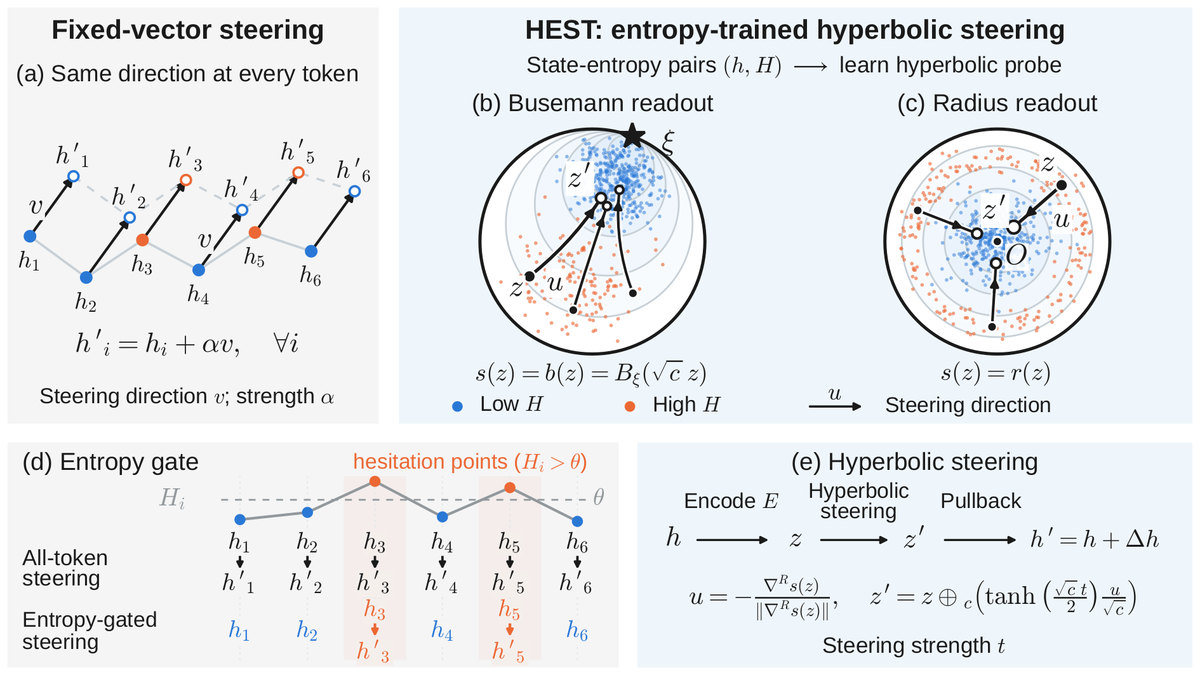
Overview of HEST: the entropy gate, the hyperbolic probe and the steering step Preprint

Hesitation Has a Geometry: Entropy-Trained Hyperbolic Probes for Sparse Activation Steering

Zeyong Zhang, Tung Sum Thomas Kwok, Tengfei Ma, Mengjia Xu

arXiv preprint, 2026

HEST steers a language model only at the tokens where it hesitates. An entropy gate decides when to act, and a hyperbolic probe trained on the model's own next-token entropy, with no answer labels, decides how. On MATH-500 and GSM8K it improves greedy accuracy of Qwen2.5-Math and Llama-3.1 models while touching about one to three percent of the tokens.
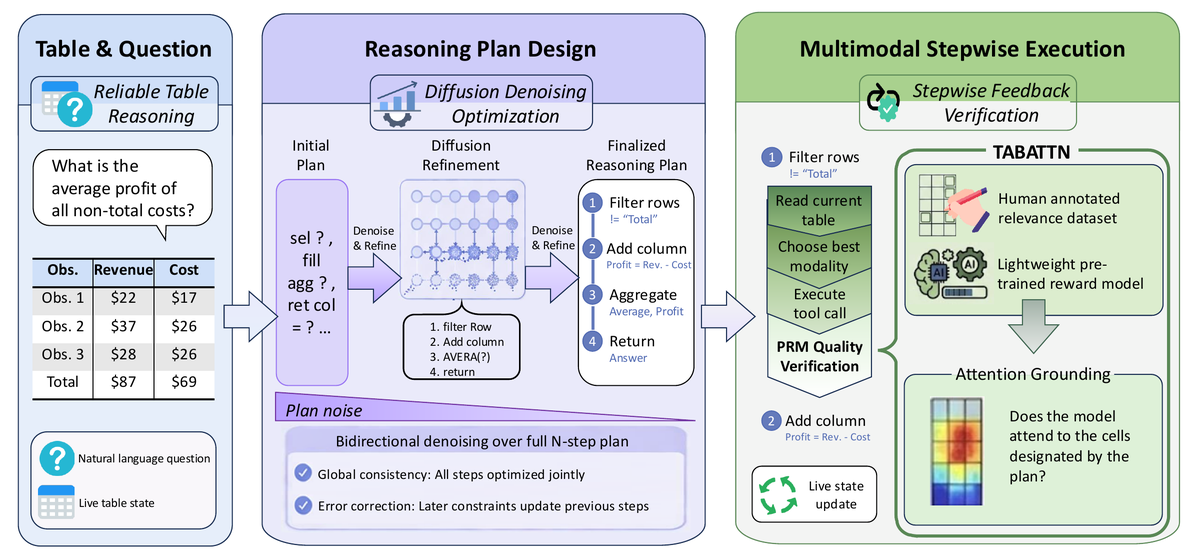
Overview of TabAlign NeurIPS 2026

From Table to Cell: Attention for Better Reasoning with TabAlign

Tung Sum Thomas Kwok, Zeyong Zhang, Xinyu Wang, Chunhe Wang, Xiaofeng Lin, Hanwei Wu, Lei Ding, Guang Cheng, Zhijiang Guo

A planned table reasoning framework. A masked diffusion planner writes each reasoning step as a binary mask over table cells, and a lightweight verifier scores each step by how well the reasoner's attention overlaps the designated cells. Across eight table question answering and fact verification benchmarks, TabAlign improves average accuracy by 15.76 points over the strongest open-source baseline of comparable size.

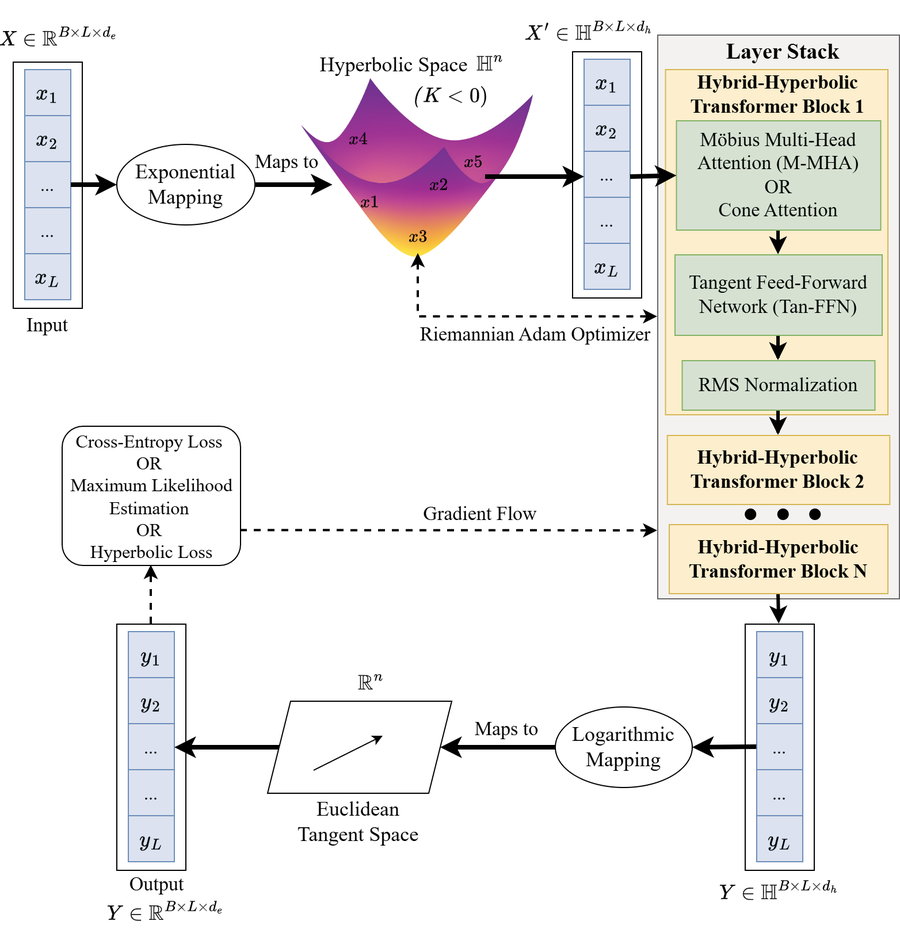
Hybrid hyperbolic-Euclidean architecture from the survey SIAM Review

Hyperbolic Large Language Models

Sarang Patil, Zeyong Zhang, Yiran Huang, Tengfei Ma, Mengjia Xu

SIAM Review, accepted, to appear

A survey of large language models that use hyperbolic geometry as their representation space. It organizes existing models into four categories (hyperbolic LLMs through exp/log maps, hyperbolic fine-tuned models, fully hyperbolic LLMs, and hyperbolic state-space models), reviews applications, and outlines open directions. A curated list of papers, models, datasets and code is maintained on GitHub.

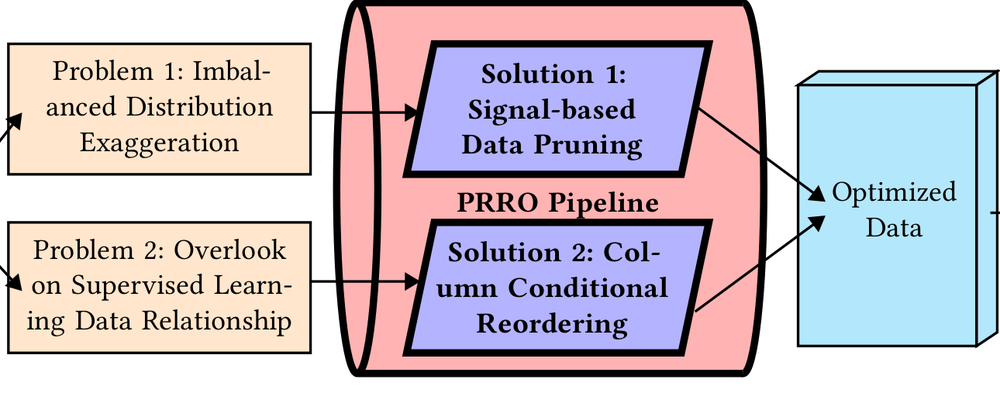
The PRRO pipeline: data pruning and column reordering KDD 2025 Workshop

Towards High Supervised Learning Utility Training Data Generation: Data Pruning and Column Reordering

Tung Sum Thomas Kwok, Zeyong Zhang, Chi-Hua Wang, Guang Cheng

KDD 2025 Workshop on Evaluation and Trustworthiness of Agentic and Generative AI Models

PRRO brings data-centric techniques to tabular data synthesis: data pruning guides the generator toward observations with a high signal-to-noise ratio, and column reordering aligns the generator with the downstream supervised model. On 22 public datasets, synthetic data produced with PRRO trains better supervised models than data produced without it.

News

  • Sep 2026From Table to Cell: Attention for Better Reasoning with TabAlign is accepted to NeurIPS 2026.
  • Nov 2025Hyperbolic Large Language Models is accepted to SIAM Review.
  • Sep 2025Started my Ph.D. in Data Science at NJIT, advised by Prof. Mengjia Xu.
  • Jul 2025Towards High Supervised Learning Utility Training Data Generation: Data Pruning and Column Reordering is accepted to the KDD 2025 Workshop on Evaluation and Trustworthiness of Agentic and Generative AI Models.
  • Jan 2025Graduated from the M.S. in Mathematical Finance and Financial Technology program at Boston University.

Honors and Awards

  • Graduation with High Honors, Boston University, Questrom School of Business (2025)
  • Dean's Achievement Scholarship, Boston University, Questrom School of Business (2023)
  • Dean's Award for Achievement, University of Manchester (2023)

Service

  • Reviewer: IEEE International Conference on Systems, Man, and Cybernetics (SMC 2026)

Beyond Research

Outside research, I enjoy playing badminton, and I am a long-time fan of ACG culture: anime, comics and games.